
Greene County Court Records After Arrest
After a Greene County jail arrest, the jail record and the court record are related, but they are not the same record. The sheriff roster or OCV profile may show booking facts, custody status, physical description, holding facility, reporting agency, and a booking charge code. The court record is the formal case file where prosecutors, municipal courts, and common pleas courts manage charges, bond orders, hearing dates, dispositions, and sentencing.
The charge on the booking profile can differ from the charge later filed in court. Prosecutors can add, amend, reduce, dismiss, or indict charges after reviewing reports and evidence. For current custody and booking detail, use Greene County jail inmate records. For booking photos, use Greene County jail mugshots. Court records after a jail arrest should be checked in the court system that owns the case.
Search Greene County Court Records
The main county case-search route is Greene County CourtView/eServices. The official app shell is JavaScript, but court and clerk source text identifies it as the search system for case number, case type, names, attorney, and ticket or citation searches. The Greene County Clerk of Courts files, dockets, indexes, and preserves pleadings for civil, felony criminal, and domestic relations cases. The clerk also collects court costs, bonds, fines, and forfeitures, and may issue writs tied to court orders, including warrants to arrest.
- Start with CourtView/eServices for county and common pleas case records after a Greene County arrest.
- Search by defendant name, case number, case type, attorney, or ticket/citation number where the system allows it.
- Open the case docket and compare the filed charge to the booking charge shown on the jail record.
- Review bond entries, hearing dates, warrant entries, plea or disposition lines, and sentencing entries.
- For older or unclear records, contact the Clerk of Courts or use the public-records route for the office that keeps the record.
The CourtView screenshot at courts.greenecountyohio.gov/eservices shows the official case-search shell used for Greene County court records after arrest.
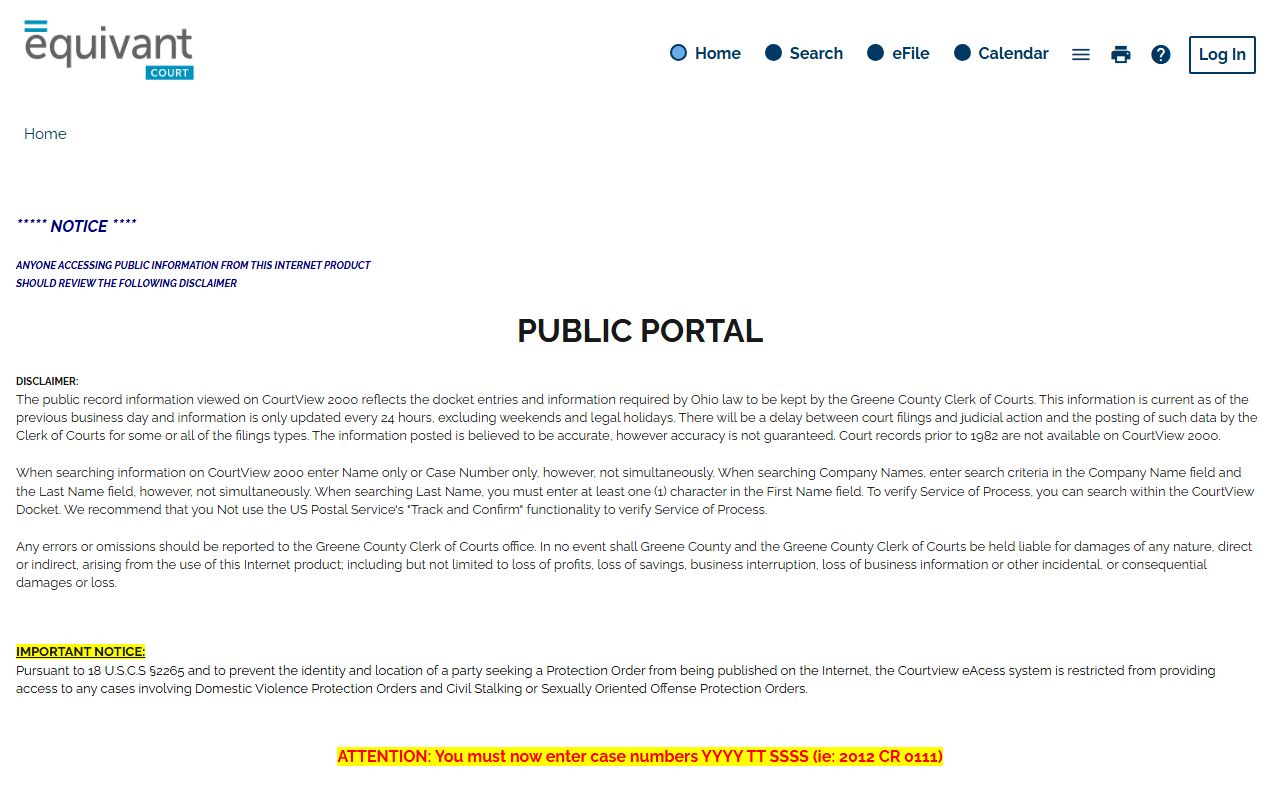
That court-search route is the correct place to confirm formal charges and case status after checking the jail roster for custody.
Greene County Arrest Court Paths
Greene County court records after a jail arrest may start in more than one court. Fairborn Municipal Court serves Fairborn, Bath Township, Beavercreek, and Beavercreek Township. It handles preliminary felony hearings, traffic and non-traffic misdemeanors, civil disputes within its limit, and small claims. Felony criminal cases ultimately belong in Greene County Common Pleas Court if they are prosecuted as felonies after preliminary steps. Xenia Municipal Court is also part of the local court path for Xenia matters.
| Court Route | Use It For | Record Clues |
|---|---|---|
| Greene County CourtView/eServices | Common pleas and county case searches. | Case number, case type, names, attorney, ticket or citation search. |
| Fairborn Municipal Court | Fairborn-area misdemeanors, traffic, and felony preliminary hearings. | Name, case number, ticket number, hearing date, and file date search fields. |
| Clerk of Courts | Older, unclear, or in-person record requests. | Felony criminal filings, bonds, fines, writs, and warrants tied to court orders. |
| Prosecuting Attorney | Charging decisions and victim/witness services. | Explains why court charges may differ from booking charges. |
Fairborn Arrest Case Search
Fairborn Municipal Court provides the clearest captured static search-field table. Its search page is useful when an arrest came from Fairborn Police, Beavercreek Police, Wright State University Police, or another agency using Fairborn Municipal Court housing or arraignment routes. The form warns users to be specific by name, to use numbers only for case or ticket searches, and to complete all date fields for date searches.
| Field Label | Type | Required | Options / Format Notes |
|---|---|---|---|
| Name/Company | Text | No | Use last name, comma, space, first or middle name when searching full name; maximum 30 characters. |
| Case Number | Text | No | Numbers only, no letters or dashes; maximum 8. |
| Ticket Number | Text | No | Numbers only, no letters; maximum 7. |
| Hearing Date | Month/day/year fields | No | Month dropdown, day field, and year field should all be filled. |
| File Date | Month/day/year fields | No | Month dropdown, day field, and year field should all be filled. |
| Show Matches | Dropdown | No | 25, 50, 100, or 250 results. |
| Begin Search | Submit | Yes to submit | Submit is protected by reCAPTCHA. |
The Fairborn search screenshot at fairbornmunicipalcourt.us/search.php shows the municipal case form used for Fairborn-area court records after arrest.
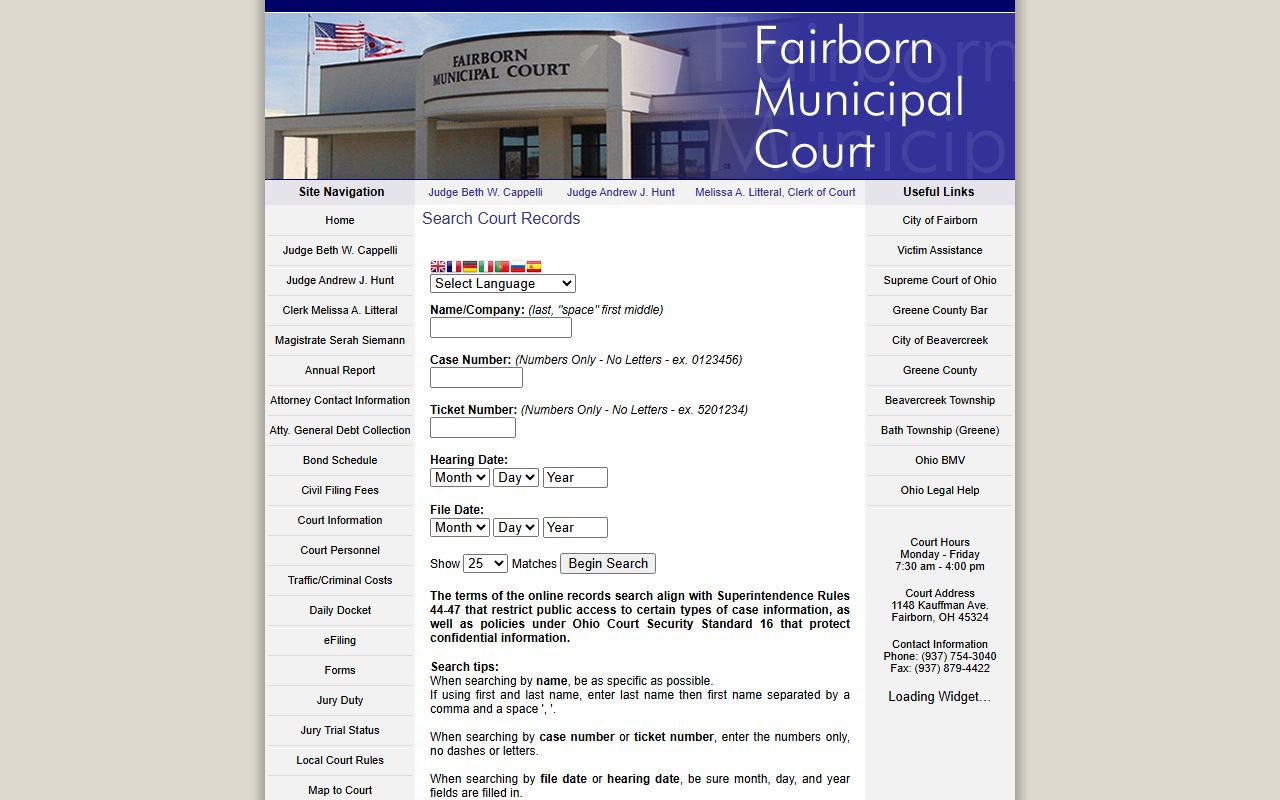
This is a municipal court route, so felony cases should still be checked in common pleas if prosecution moves beyond preliminary proceedings.
Charging Records After Arrest
Arrest and booking create the jail side of the record. The court record begins when a charging document starts or advances the case. In Greene County, municipal courts may handle misdemeanors and felony preliminary hearings. The Greene County Prosecuting Attorney reviews facts and files or continues charges by complaint, information, or indictment depending on the case type and stage.
| Document | Who Uses It | What It Does |
|---|---|---|
| Complaint | Officer or prosecutor | Initial charging document often used in municipal or preliminary case stages. |
| Information | Prosecutor | Prosecutor charging instrument often used with waiver or plea procedures. |
| Indictment | Grand jury | Grand jury charging instrument, often used for felony prosecution in common pleas court. |
Greene County Charge Status
Court records after a jail arrest should be read by charge status, not just by the first charge seen on a jail profile. A charge may be open, changed, reduced, dismissed, or resolved by plea or verdict. The docket is the best source for the formal status because the booking charge may be only an early custody label.
| Status | What It Means |
|---|---|
| Pending | The charge or case remains open. |
| Amended | The charge was changed by prosecutor or court action. |
| Reduced | The charge moved to a lower offense or degree. |
| Dismissed | The charge was removed without conviction. |
| No bill | The grand jury did not indict on that charge. |
| Disposition | The current or final outcome, such as plea, conviction, dismissal, or sentence. |
Bond Records After Arrest
Greene County jail sources did not publish accessible jail-counter instructions for posting bond, accepted jail payment methods, or bond-posting hours. Bond should be treated as a court issue. The Fairborn Municipal Court bond schedule states that there is a presumption of personal bond for misdemeanor charges unless otherwise provided by statute, and that a judge or magistrate sets bond when personal recognizance is not enough or when the case type requires more conditions.
| Bond Type | How It Works |
|---|---|
| Personal recognizance / personal bond | Release based on a promise to appear and comply with court conditions. |
| Cash bond | Money deposited through the court or authorized office to secure appearance. |
| Surety bond | Bond posted through a surety approved by the court clerk where allowed. |
| Conditional bond | Release with terms such as no contact, testing, supervision, or travel limits. |
| No-bond hold | Release is blocked by a court order, warrant, detainer, probation/parole hold, or another jurisdiction. |
Note: The jail can answer custody questions, but bond amount and payment method should be confirmed with the court or authorized bond office.
Warrants And Arrest Records
No official searchable Greene County Sheriff active-warrant database was located. Use the sheriff warrant contact found in official search text, court dockets, municipal court dockets, the sheriff Most Wanted page, and public-records routes instead of relying on a single warrant search. Most Wanted is a selected law-enforcement list, not a full active-warrant index.
- Arrest warrant
- Authorizes arrest based on a criminal case, complaint, or court order.
- Bench warrant
- Issued by a judge, often for failure to appear or failure to comply.
- Search warrant
- Authorizes a property or evidence search and is not the same as an arrest warrant.
- Holder or detainer
- A hold from another case, agency, jurisdiction, or supervision office that may block release.
Charges Versus Convictions
A Greene County arrest, a filed charge, and a conviction are different stages. An arrest means a person was taken into custody. A charge is an accusation filed or maintained in court. A conviction is a legal outcome after a plea, verdict, or finding of guilt. Court records after an arrest should be read with that sequence in mind.
| Item | Charge | Conviction |
|---|---|---|
| Stage | Accusation in an open or filed case. | Final guilt finding or plea outcome. |
| Proof level | Based on charging standards and court review. | Requires plea, verdict, or other final legal finding. |
| Can change? | May be amended, reduced, dismissed, or indicted. | May be appealed, sealed, expunged where eligible, or used in sentencing. |
Sealed And Expunged Records
Ohio law gives eligible people routes to limit public access to some criminal records. Greene County Clerk materials link local sealing forms and cite O.R.C. 2953.32 for eligible conviction records. Research also identified O.R.C. 2953.33 for records after not guilty findings, dismissals, no bills, or pardons, and O.R.C. 2953.34 for effects and compliance rules.
| Item | Sealed | Expunged |
|---|---|---|
| Public access | Generally hidden from public case search where the order applies. | Destroyed, deleted, or treated more completely as removed where the law allows. |
| Agency access | Some limited government or law-enforcement access may remain. | Access is more limited, subject to the statute and court order. |
| Eligibility | Depends on offense, timing, disposition, notice, hearing, and statutory exceptions. | Depends on Ohio law and the specific court order. |
Greene County Prosecutor Records
Ohio uses the title Prosecuting Attorney, not District Attorney. The Greene County Prosecuting Attorney is David D. Hayes. The office prosecutes adult felony crimes, juvenile offenses, and provides legal counsel to county and township officials. Its charging role explains why court records after a jail arrest can change after the first booking charge appears on the sheriff profile.
The Victim/Witness Division provides crisis intervention, emotional support, victims' rights advocacy, case status notification, court accompaniment, and referrals for felony crime victims and witnesses in Greene County Common Pleas Court and Juvenile Court. Those services are separate from the public court-record search and do not replace the clerk docket.
Restricted Greene County Court Records
Not every court record after an arrest is fully public online. Ohio's public-access rules, court security rules, juvenile-record limits, sealed-record orders, expungement orders, and ongoing-investigation exemptions can limit what appears in a public portal. If a record should exist but is not visible online, use the court clerk, prosecutor, sheriff, or county public-records channel that owns the record. A public-records request should identify the person, case number if known, date range, court, and record type with reasonable clarity.
Important: This resource is not a consumer reporting agency, and court or jail information may not be used for FCRA-covered decisions.